New Year's Lucky Money, and the Question of Whether to Play the Lottery or Buy Insurance?
Introduction
At the beginning of the new year, you visit a mathematician's house. When you ask for lucky money, the mathematician gives you two choices:
- Lucky envelope A contains 240 thousand VND.
- Lucky envelope B has a 25% chance of containing 1 million VND, and a 75% chance of containing nothing.
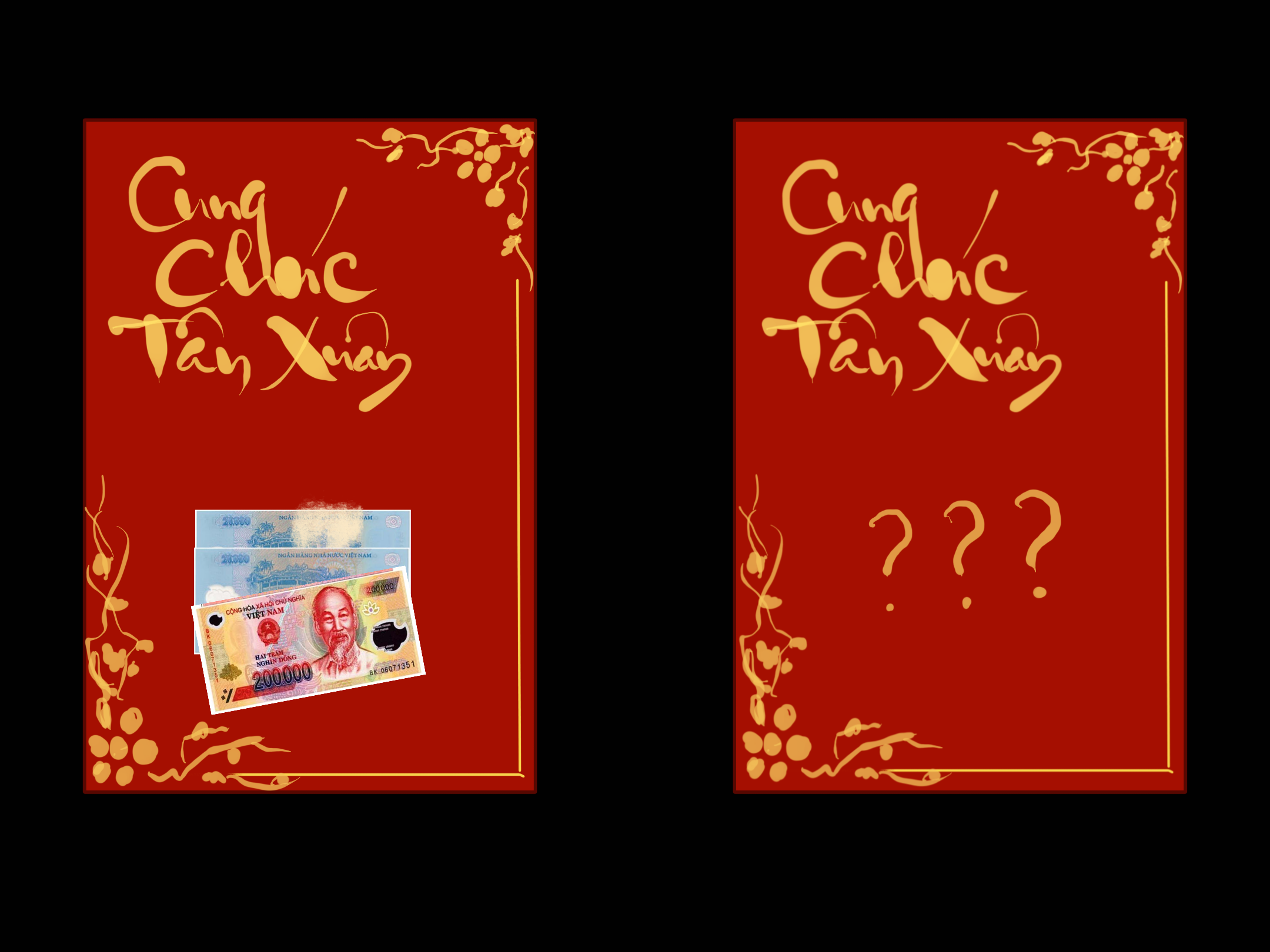
Which lucky envelope would you choose? As a math lover, you immediately sit down to calculate. Lucky envelope B has an expectation of 25% × 1 million + 75% × 0 = 250 thousand, which is 10 thousand higher than the expectation of lucky envelope A. But is that 10 thousand enough for you to accept the 75% risk of receiving nothing?
Later, the mathematician's young daughter runs out asking for your lucky money, and also gives you two choices:
- Lucky envelope C: you will have to give 740 thousand VND.
- Lucky envelope D: you have a 25% chance of not having to give anything, and a 75% chance of having to give 1 million VND.
Once again, you apply your mathematical knowledge and calculate the expectation of each choice. The expectation of choice C is -740 thousand, and of D is 25% × 0 + 75% × (-1 million) = -750 thousand. So choice C has an expectation 10 thousand higher, but if you choose C, you'll definitely lose money, while if you choose D you have a 25% chance of losing nothing at all.
If you chose lucky envelope A in the first situation and lucky envelope D in the second situation, you belong to the majority. When conducting this experiment, researchers found that over 70% of participants chose A and D, despite these two choices not being optimal in terms of expectation. This can be explained through phenomena that psychologists/economists call risk aversion and loss aversion. In the first situation, choice A is more attractive because it has no risk, even though the expected money is slightly less. In the second situation, choice D gives you a 25% chance of no loss, so it's somewhat more attractive than accepting loss with 100% probability.
So is there anything wrong with choosing A and D? While not mathematically optimal, avoiding risk and disliking losses is also normal and reasonable, right? This might be true when you consider the two situations separately, but what if we combine both situations to see what you'll get after leaving the mathematician's house?
- Lucky envelopes A+D: you definitely receive 240 thousand, but with 75% probability lose 1 million, so you have a 75% chance of losing 760 thousand, and 25% chance of gaining 240 thousand.
- Lucky envelopes B+C: you definitely lose 740 thousand, but receive 1 million with 25% probability, so you have a 75% chance of losing 740 thousand, and 25% chance of gaining 260 thousand.
Clearly choice B+C is better than A+D in every way, so why did we choose A and D?
Note that in this example, the numbers 25%, 250 thousand, 1 million affect the decision-making. If we replaced 25% with a very small probability like 1% or very large like 99%, or replaced 1 million with 100 million, the problem would become completely different. And of course, if you encountered this situation in real life, you probably would have packed up and left the mathematician's house when the mischievous daughter demanded lucky money. However, we cannot deny that this experiment shows that humans sometimes don't act according to logic.
Should We Buy Insurance or Play the Lottery?
Human psychology doesn't always work according to mathematics. We choose to buy health insurance even though we know the probability of serious illness is very small, and mathematically the expected money received is less than the monthly insurance premiums we pay, because we know that having insurance gives us peace of mind and avoids large losses in case of serious illness. We buy lottery tickets even though we know the probability of winning is very low and the expected return is much less than the ticket price, but it gives us hope and the right to dream about a life-changing opportunity.
This psychology may not be very harmful if we only buy lottery tickets a few times, but if we play monthly or yearly, we're almost certain to lose money (except for the very few who win the jackpot). Gambling at casinos or other forms of betting are similar. If we only fly once, buying flight insurance to have peace of mind is very reasonable, but if we fly more than ten times a year and buy insurance every time when the probability of getting sick or missing flights is very small, we've wasted a considerable amount of money. When deciding whether to buy stocks of a company or invest in a business opportunity, if we only invest once, choosing a low-risk option is reasonable, but if we invest many times, accepting risk can bring greater long-term profits.
Why Study Math?
Sometimes people ask me what's the point of studying math - if you're not pursuing engineering, economics, don't need complex calculations in your work, what's the use of studying math? A simple reason is: study math to make the right decisions. With each individual situation, you might choose a non-optimal way (mathematically speaking), but according to the law of large numbers, because life is a long series of decisions, if you always make non-optimal choices, small things accumulate into big things, and there will come a time when you realize you've wasted too much time or money. So next time you decide whether to buy insurance, play the lottery, invest in business..., I hope you'll think soberly like a mathematician!